
Tennis is uniquely challenging among major global sports because its playing environment changes drastically throughout the competitive calendar. While basketball courts and soccer pitches maintain uniform playing conditions across venues, tennis is played on fundamentally distinct surfaces: clay, grass, hard courts, and indoor carpet. Each surface possesses unique physical characteristics that dictate ball speed, bounce height, traction, and overall court movement.
These physical variables directly influence match tactics, rally lengths, equipment selection, and player movement patterns. A playing style that dominates on the fast grass of Wimbledon may struggle on the slow, high-bouncing red clay of Roland Garros. Understanding how court surfaces dictate tennis mechanics reveals the deep strategic complexity underlying the modern game.
The Physical Mechanics of Surface Interaction
To understand why playing styles vary across courts, one must first analyze the physics of the ball-surface interaction. When a tennis ball strikes the ground, two key physical phenomena occur: friction and energy absorption.
-
Friction and Horizontal Speed: High-friction surfaces grip the ball upon contact, slowing its forward momentum and transferring that horizontal energy into vertical rotation or bounce. Low-friction surfaces allow the ball to slide, preserving its forward velocity and creating a skidding effect.
-
Vertical Energy Absorption and Bounce Height: Harder, more rigid surfaces absorb minimal energy, sending the ball rebounding high into the air. Softer or looser surfaces absorb a portion of the ball’s kinetic energy, altering both the height and predictability of the bounce.
-
Footwear Traction and Movement: Movement mechanics vary wildly by surface. Clay allows players to slide into shots with controlled footwork, hard courts demand sharp stopping and explosive directional changes, and grass requires careful balance to avoid slipping on damp turf.
Clay Courts: The Domain of Patience, Topspin, and Endurance
Clay courts, constructed from crushed brick, shale, or stone, represent the slowest surface in professional tennis. The loose top layer of crushed brick creates high friction when the ball strikes the ground, significantly reducing forward velocity while amplifying topspin rotation.
High Bounces and Extended Rallies
Because clay absorbs horizontal speed and enhances topspin, the ball bounces significantly higher than on other surfaces. This high bounce drives players far behind the baseline to hit shots at a comfortable waist-height strike zone. Consequently, winning immediate points with flat, high-speed serves or aggressive forehands becomes difficult. Rallies on clay are naturally longer, turning matches into grueling physical tests that reward endurance, consistency, and patience.
Tactical Construction and Heavy Topspin
To succeed on clay, players cannot rely solely on raw power. They must construct points methodically, using heavy topspin to push opponents far behind the baseline and opening up wide angles to exploit court space. Heavy topspin shots clear the net with a high safety margin and jump violently off the gritty surface, forcing opponents to hit backhands above shoulder level. Drop shots are also exceptionally effective on clay because the soft surface deadens the ball’s bounce, making recovery sprint attempts extremely difficult.
The Art of Sliding Movement
Movement on clay is distinct because players can initiate a slide before hitting the ball, arriving at the shot in a balanced stance and recovering toward the center court immediately upon contact. Mastering the clay slide requires precise timing, strong core stability, and high confidence in foot traction. Players who struggle to slide often lose their foot posture and struggle to change direction smoothly during long baseline exchanges.
Grass Courts: Speed, Precision, and Low-Bounce Volleys
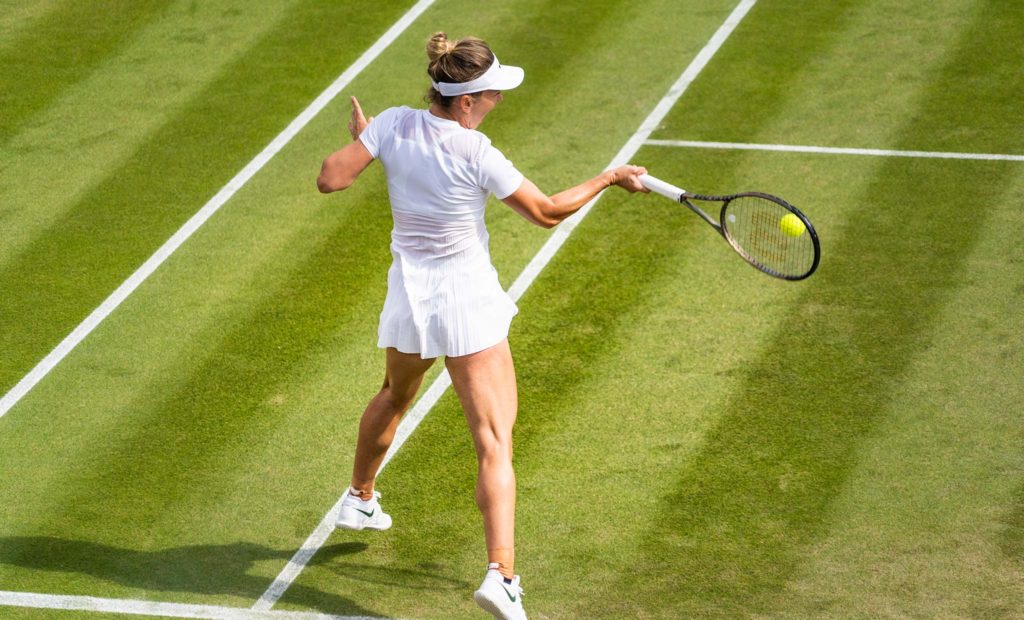
Grass is the traditional surface of tennis, best exemplified by the pristine lawns of Wimbledon. As a living, organic surface, grass creates a fast, low-bouncing, and unpredictable environment that favors aggressive, proactive playing styles.
Low Friction and the Skidding Effect
Grass blades bend upon impact, creating a low-friction surface that allows the ball to skid smoothly without losing horizontal speed. The ball stays low to the ground, rarely rising above waist height. This physical characteristic deprives baseline players of the time needed to wind up full, heavy topspin swings, rewarding players who hit flat, low-trajectory shots with short backswings.
Serve-and-Volley and Net Dominance
Historically, grass courts were dominated by serve-and-volley specialists who capitalized on powerful serves and rushed the net to finish points with crisp volleys. While modern racquet technology and altered turf mixtures have made baseline play more viable on grass, aggressive net play remains a potent strategy. A powerful serve on grass skids through the court quickly, forcing weak defensive returns that can be put away easily at the net.
Unpredictable Bounces and Movement Precision
Because grass wears down over the course of a tournament—transitioning from lush green turf to exposed soil—bounces become increasingly erratic. Players must maintain a low center of gravity, bend their knees deeply, and prepare for unexpected bad bounces. Movement on grass requires small, controlled adjustment steps to maintain footing, as sudden, aggressive stops can cause foot slippage and physical injury.
Hard Courts: The Balanced Neutral Ground
Hard courts, typically constructed of asphalt or concrete covered with acrylic resin and sand mixtures, represent the most common surface in global tennis. Hard courts sit directly in the middle of the spectrum, offering a balanced environment that blends the speed of grass with the bounce predictability of clay.
Predictable Speed and Uniform Bounce
The rigid foundation of a hard court ensures a uniform, highly predictable ball bounce. Unlike grass or clay, hard courts feature minimal surface variations, allowing players to time their shots with extreme precision. The speed of a hard court can be adjusted during construction by altering the amount of sand mixed into the acrylic topcoat; adding more sand increases friction to slow the court down, while less sand yields a slicker, faster surface.
The Rise of the Aggressive Baseline Style
Because hard courts reward both powerful baseline hitting and dynamic court coverage, they have fostered the dominant modern tennis style: the aggressive baseliner. Players on hard courts can hit flat, penetrating groundstrokes or heavy topspin shots with equal effectiveness. They use physical power to dictate play from the baseline while relying on explosive lateral movement to defend all four corners of the court.
High Physical Strain on Joints
The absolute rigidity of concrete and asphalt offers excellent foot traction, allowing players to plant their feet firmly and explode into directional changes. However, this lack of give subjects a player’s ankles, knees, and lower back to significant impact shock. Sliding on hard courts has become common among modern professional athletes, but it demands exceptional lower-body strength and specialized footwear to avoid joint injury.
Indoor Carpet and Fast Synthetic Courts
While less common on the professional tour today, indoor carpet courts feature textile surfaces laid over concrete foundations. Carpet courts are exceptionally fast, with very low friction and minimal bounce height. On carpet, rallies are brief, serves dominate match outcomes, and aggressive flat hitting completely overshadows defensive baseline play.
Frequently Asked Questions
Why do European players historically excel on clay courts compared to American players?
European players often grow up training predominantly on red clay courts, which naturally instills early habits of patient point construction, heavy topspin mechanics, and slide movement techniques. Conversely, American youth development relies heavily on hard courts, which reward direct power, flat serves, and aggressive early-ball striking.
How does ball selection change based on the playing surface?
Tournament organizers tailor tennis balls to balance surface characteristics. Extra-duty felt balls, featuring thicker wool covers, are used on abrasive hard courts to resist wear. Regular-duty felt balls are used on clay and indoor courts because loose debris would clog thicker felt, while pressureless or specialized high-altitude balls are deployed in elevated venues to maintain standard bounce heights.
Why do players switch shoes when moving between clay, grass, and hard courts?
Outsole tread patterns are specifically engineered for each surface’s traction requirements. Clay shoes feature a dense herringbone or zig-zag tread that grips loose brick dust while allowing controlled sliding. Grass shoes use tiny rubber nubs on the outsole to provide traction on damp turf without tearing up delicate grass. Hard court shoes use durable, modified herringbone patterns with reinforced toe caps to withstand abrasive friction.
How has court speed changed at major tournaments over the past two decades?
In the early 2000s, grand slam venues moved to homogenize playing speeds to promote longer, more spectator-friendly rallies. Wimbledon altered its grass mix to one hundred percent Perennial Ryegrass and used heavier balls to slow down play, while the French Open adjusted its clay density. This shift reduced the absolute dominance of serve-and-volley specialists on grass and made aggressive baseline play effective across all four grand slam events.
How does temperature and humidity affect how a court surface plays?
Warm temperatures increase air pressure inside the tennis ball, causing it to bounce higher and travel faster through the air, which accentuates the high bounce on clay. High humidity makes the air denser and heavy, slowing ball flight speeds, while dampness on grass or clay softens the surface, deadening the bounce and creating heavier court conditions.
Can a player alter their racquet setup to adapt to different court surfaces?
Yes, players frequently adjust their racquet specifications when changing surfaces. On fast surfaces like grass, players may increase string tension slightly to gain added ball control against high incoming speeds. On slow clay courts, players often lower string tension by two to four pounds to generate effortless depth, power, and spin during extended baseline exchanges.
What is the transition season, and why is it so physically challenging for professional players?
The transition season refers to the rapid calendar shifts between distinct surface swings, such as moving from the hard courts of the spring directly onto European clay, followed by a brief three-week jump onto grass for Wimbledon. Shifting between these surfaces forces athletes to adjust their footwork mechanics, muscle usage, and tactical mindset within days, creating high physical fatigue and elevated injury risks.